

Resistance of ember and.., p.1
Resistance (Of Ember and Flame Book 1), page 1
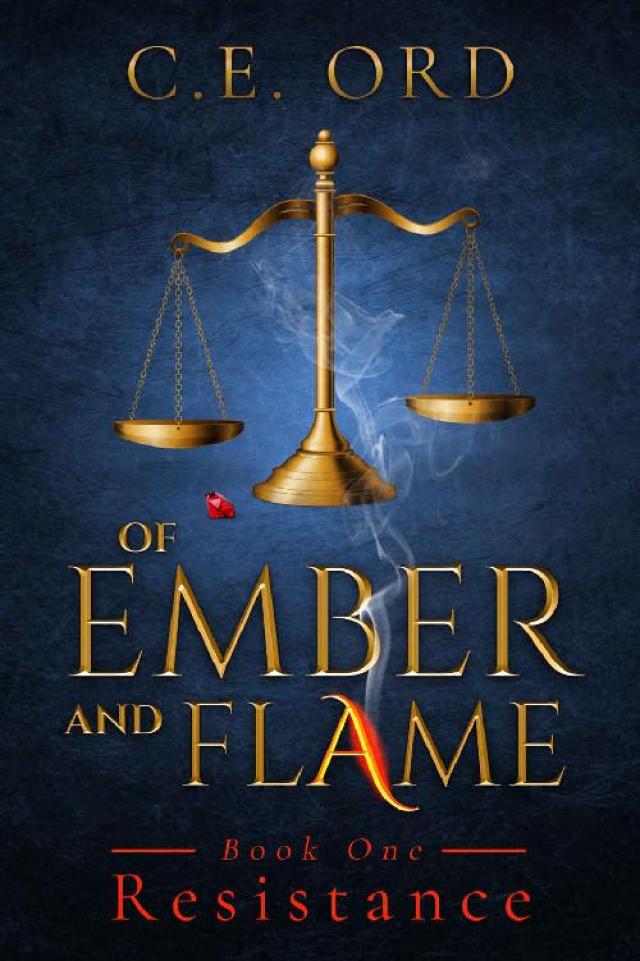


Resistance
Of Ember and Flame, Book One
C.E. Ord
OH Publishing
Copyright © 2021 C.E. Ord
All rights reserved
The characters and events portrayed in this book are fictitious. Any similarity to real persons, living or dead, is coincidental and not intended by the author.
No part of this book may be reproduced, or stored in a retrieval system, or transmitted in any form or by any means, electronic, mechanical, photocopying, recording, or otherwise, without express written permission of the publisher, except by a reviewer who may quote brief passages in a review.
ISBN-13: 9780645361001
Cover design by: Angela Haddon Book Cover Design
For Freya and Tom—the reasons I believe in magic.
Map not to scale
Chapter One
“Lia . . . Lia? Detention is finished.”
Ms. Bennett was looking at me expectantly from her seat behind the teacher’s desk at the front of the classroom, gesturing to the clock above the whiteboard behind her.
I rose silently from my seat at the rear of the classroom by the windows that looked out over Marshall Hall’s grassy, manicured quadrangle. Scooping my bag up from where I’d dropped it on the floor an hour earlier, I made my way to the front of the room. I deposited my detention slip onto the desk in front of the elderly Ms. Bennett and waited while she signed it and then tucked it away in her folder.
I’d been her only charge in detention that afternoon—in fact, I’d been the only attendee in detention every afternoon that week. My fellow students at Marshall Hall weren’t exactly a wild bunch.
I was supposed to have spent the hour studying, but I’d mostly just stared out the window. The huge, grassy quad out beyond the window was edged with giant old jacaranda trees. The trees’ signature purple blossoms were somehow still more or less in full bloom despite Sydney’s excessive early summer heat. Ms. Bennett had read a book for the entire hour and had not taken issue with my idleness. I wasn’t sure if she was going easy on me because it was the last day of the school year, or just because she was nice, or because she secretly agreed with me that Mr. Hinkley was an archaic jerk. It might have been a mix of all three.
“Lia?” Ms. Bennett’s tone was gentle, and she looked at me carefully as she stood and picked up her folder and pens from the desk. I tensed a little as I waited for her to continue, but she suddenly seemed to change direction and simply said, “Have a good holiday, kiddo. Fresh start next year.”
Kiddo. None of my teachers in the States would have ever called me kiddo. But in my almost twelve months Down Under, I’d learned that Australians love a nickname. For anyone, and anything. They can shorten almost any label, and if your name’s already short, they’ll go ahead and give you a nickname that makes it longer. Their commitment to informality is impressive.
Ms. Bennett was waiting for my response; the slightest hint of a reserved smile gently creasing the weathered skin around her kind, startlingly blue eyes.
I worked to push down my completely unreasonable irritation. Irritated was pretty much my default setting these days. My attitude wasn’t even intentional at this point—in fact, it never really had been. Lia from twelve months ago wouldn’t have been irritated—she wouldn’t have ever wound up in detention, either, for that matter. But a lot had changed since then, and not much of it for the better.
But while life as I knew it had undeniably imploded, and my attitude, grades, and previously bubbly enthusiasm for life in general had all more or less tanked somewhere along the way, I wasn’t a complete jerk. Ms. Bennett was nice, and she meant well. If there was anyone at school—other than Tyler, of course—who was in my corner, rooting for me, it was Ms. Bennett. And I knew I should be more grateful for that than I was.
Not that anyone at school was against me, as such. The students were all nice and friendly, and the teachers had been nothing but welcoming and accommodating. But as the months had worn on after Tyler and I started at Marshall Hall—a fancy private school in one of Sydney’s more upscale suburbs—it had been quite evident that much of the faculty’s patience had started to wane. They wanted the happy, outgoing, well-behaved, straight-A student they’d been promised. Being orphaned and shipped halfway around the world to live with your aging grandmother scored you a lot of goodwill and leniency, but people had their limits. And I couldn’t really blame them; I was pretty annoyed by myself these days, too.
“Lia?” Ms. Bennett tried again, shuffling her folder in her hands and slipping her purse over her shoulder as she spoke. “Go on.” She nodded toward the classroom door. “Go have a great summer, okay? You’re a good kid; go enjoy yourself.”
Her words, though not at all out of character for the kindly literature teacher, still somehow caught me off guard. I looked away, working quickly for a moment to swallow down the unexpected lump that suddenly rose in my throat.
Ms. Bennett stepped around the small table and gently squeezed my shoulder with one hand. “Wish your grandmother a Merry Christmas for me.”
“I will. Thank you,” I said quickly, heading for the door with barely a glance back in the gracious elderly teacher’s direction.
Walking down the long hall of Building C, I shook my head in frustration at myself before pushing all thoughts of school, detention, and my disastrous year in general from my mind. Fresh start next year—maybe Ms. Bennett was right. Maybe next year I’d get my emotions and attitude, and my life, back under control. Maybe.
School was eerily still and silent. As I made my way toward the front of the campus, there wasn’t a single person to be seen. Every bulletin board was stripped bare, every locker empty, not a school bag or a forgotten sweater in sight.
One of the many jarring differences between Australia and Ardsley, New York, where Tyler and I were born and had lived with our parents up until eleven months ago, was that the school year ran from January to December in Australia. Bizarrely, after several months of tenth grade last year in New York, we’d arrived in Australia in January of this year, just in time to start our sophomore year all over again. When Tyler and I returned to school at the end of January next year, we’d be starting the eleventh grade. All our friends back home had started their junior year three months ago, in September.
Pushing out through the heavy wooden doors at the front of the building, I stepped into the baking sun. I paused a moment, waiting for my eyes to adjust to the glaring sunlight as the weighted doors thunked closed behind me.
Summer in Australia was no joke. Trying to translate their Celsius temperature scale to the Fahrenheit I was used to was generally a pointless and confusing exercise, but the precise numbers weren’t necessary to know that it was hot. Really, really hot. All the time.
It had been a half-day of classes today, and it was well past an hour now since the final bell had rung on the last day of the school year. The yard outside was as deserted as the buildings I had just walked through, save for one lone figure. Tyler was sitting propped against the wall of the building I had just exited, positioned in the small expanse of shade the tall building was casting on the ground below it.
“Ty,” I said, smiling as my twin picked himself up from the ground and slung his bag over his shoulder before sauntering over to meet me. “I told you not to wait. You must be melting.” I’d told Tyler that morning on the way to school not to wait for me while I was in detention, though I’d known even as I’d said it that he would wait regardless. We’d always been exceptionally close, as twins tended to be, but never more so than now.
“Ready to go?” he asked with a grin, taking my backpack from my hands and slinging it up onto his shoulder with his own pack. Tyler had been doing this ever since I could remember, and I still didn’t understand how he managed to comfortably and effortlessly balance both of our bulky packs on only one of his broad shoulders. But somehow he did, and we’d walked home from school that way for years. “Or do you want to find some more teachers to swear at before we go? Because you might be out of luck today,” he teased, gesturing around the deserted yard.
“Ha ha,” I said dryly. “You’re hilarious.” I couldn’t say my stint in detention this week had been entirely undeserved. Mr. Hinkley, our Global Politics teacher, had not taken well to my assessment of his assessment of the relevance of freedom of speech to political debate. “That’s bullshit” had, unsurprisingly, not been well received by the easily outraged Mr. Hinkley. And while I stood firmly by the accuracy of my assessment, I’d known when I’d spoken the words that they’d been neither necessary nor appropriate. My reward for my uncharacteristic outburst had been the scandalized respect of my classmates, and a solid week of after-school detention.
“Are your friends at Circular Quay?”
“They’re your friends, too,” Tyler reminded me.
Back home, Tyler and I had both been outgoing, each of us with a close group of friends from within a larger, shared social group. Here, I’d put a pretty lackluster effort into making new friends so far, and had kind of just been swept along as part of the friendship group Tyler had joined. Another of the advantages of being a twin.
“Do you want to go?”
“Really?” Tyler asked, a surprised grin lighting his face.
“Come on, let’s go.”
My brother didn’t need to be asked twice, and we walked over to the train station, which was only a few doors down from the school. Fifteen minute
The kids from school often came here on Friday afternoons. Though joining them was kind of the last thing I felt like doing, I knew that Tyler wanted to, and that he wouldn’t have come here if I didn’t.
Spotting kids from our group waving from a patch of grass by the concourse, Ty waved in reply and moved to walk over to them.
“Um, I’m just going to walk by the water for a bit. I’ll catch up with you after,” I said, reaching to gently tug my backpack from his shoulder as I spoke.
Tyler turned, cocking his head and looking at me for a long moment. I knew he wanted to say something along the lines of, “Come on, it’ll be fun,” or, “They all really like you, Li.” But after a moment, he simply nodded, knowing it was pointless to insist, and knowing I’d only come for him.
“Okay. Call me when you’re ready to leave.” He waved his phone at me, and I nodded, smiling, and then turned and walked in the opposite direction along the concourse as Tyler headed over to the group. I could hear them all raucously welcoming him as he approached, and it made me smile.
Though the last year had unequivocally sucked, and Tyler had mourned the loss of our parents every bit as much as I had, he had just, somehow, handled it better than I had. Way better. He was happy here, and popular—just as he had been back home—and it made me happy to see him doing well.
Not that I wasn’t doing well—while it certainly couldn’t be said that I was bursting with joy, I wasn’t unhappy. Except for my recent profane outburst at Mr. Hinkley, and some general annoyance, I was doing okay. Our doting grandmother had insisted both Ty and I see a psychologist shortly after we arrived in Australia to ensure we were getting all the support we needed, given everything that had happened. And the psych—a friendly man in his mid-forties named Dr. Pritchard, who’d had pictures of his children and a severely overweight Labrador on his desk—had said I was doing just fine, all things considered.
There was a busker on the concourse. He was barefoot and shirtless, with shoulder-length, sandy hair that looked like it hadn’t seen a brush for at least a week. He was sitting on a small, faded picnic blanket on the hot concrete of the concourse right by the water, strumming a battered acoustic guitar and singing a folksy, country-ish song.
A few people were hovering around listening to the music, and I wove through the small crowd, walking over to the grass that ran along this section of the concourse, then sitting beneath the meager shade of one of the midsized trees at the rear of the grassy patch.
I’d only been sitting there a few minutes, listening to the music and absentmindedly watching people walk past along the concourse, when it happened. Just like both times before, I felt his presence before I saw him. Pulling my eyes from the harborside path gently thronging with a steady stream of foot traffic, I turned and looked about, searching. My eyes took a moment to adjust from the harsh light reflecting off the water beyond the concourse to the dappled, shaded light surrounding me.
He was probably fifteen feet away, half-sitting, half-leaning on a waist-high planter box where the grassy patch backed onto a row of shopfronts. He was dressed in very similar clothes to what he’d been wearing the two other times I’d seen him: dark pants and a long-sleeved gray T-shirt. He was watching the busker, seemingly oblivious to my presence, but then, within barely a moment of me locating him, he’d turned to meet my gaze, offering a small, cautious half-smile as our eyes met.
I sat back for a moment, perplexed. I’d seen him yesterday and the day before when we’d caught the train home from school, and now here. And each time I’d felt him, in almost exactly the same way I felt Tyler—I always knew, without looking, asking, or being told if Ty was nearby or far away, if he was happy or in trouble, what he was thinking, if he needed me. It was another one of those ‘twin things’ that always sound a bit weird to other people.
I looked over toward the planter again and saw that he was still sitting there, watching me, his gaze open, nonthreatening, a gentle curiosity coloring his direct stare.
He looked utterly normal, but somehow slightly out of place, too. It was hard to guess his age exactly. His face looked young. His smooth skin and soft brown eyes seemingly put him around my age. His height, lean but muscular frame, and broad shoulders suggested he could be a sixteen-year-old at the tail end of a growth spurt or a twenty-something with a baby face. And while he looked utterly at ease, he also kind of looked like a farmer, or someone from somewhere far away, who’d ended up in the city by accident somehow.
Still watching him, I saw him move to stand from his leaning position, and I knew, as certainly as I’d known he was there in the first place, that he was coming over to talk to me. I didn’t give him a chance to, though. I stood quickly and strode boldly across the small space between us, my eyes fixed firmly on his.
He didn’t seem threatening, and I didn’t feel scared. But the whole situation was a little bizarre, and I was going to get on the front foot, and do it in a public place, in case he actually was some type of crazy person.
“What do you want?”
He was still halfway through the motion of standing. He stopped, settling himself back down on the thick edge of the planter and smiled at me: a gentle, disarming grin. “Hi.”
Even half-sitting on the edge of the bulky concrete box, his head almost reached my standing height.
“Have you been following me?”
He hesitated a moment before answering, and when he did reply, he spoke softly, seemingly trying to soften the impact of his response with his gentle gaze. “Yes.”
A month or so back, I’d seen the teenage cashier at the local grocery store catch a guy several years older than her trying to steal a six-pack of beer. Neither she nor the offender had had any idea what to do once she’d caught him. She’d looked around in mild panic, and luckily for her, another nearby staff member had swooped in and taken over. I kind of felt like that now. I’d expected this guy to tell me I was nuts, or simply walk away, never to be seen again. Not to confirm my suspicions and then just sit there, waiting patiently for my next question.
“Well—why? Who are you?”
He finally broke his gaze from mine and looked around the grassy space. There were a few other people sitting nearby, enjoying the music. He gestured to the concourse. “Why don’t we walk, and I can answer your questions?” He paused a moment, and then continued on, watching me carefully as he spoke. “We can walk back toward where your brother is, so you know you’ll be safe.”
My head turned sharply at this, my eyes once again fixing on his. He’d been watching us—he’d followed us here. That alone should have set off alarm bells, but for some incomprehensible reason, it didn’t. There was nothing threatening, menacing, or frightening about him. I felt confused, sure, but not afraid. I wasn’t a complete idiot, though. It went against every piece of personal safety advice that is drummed into you from childhood to even talk to this guy, let alone go anywhere with him. I thought quickly for a moment before responding.
“Okay, but wait here a minute. I need to get a drink.” I gestured to the sweltering sun overhead and then behind us to one of the cafés in the long line of shopfronts skirting the concourse.
“No problem.”
I walked over to the café and through the door, heading directly to the drink fridge adjacent to the cash register. I didn’t notice the air-conditioning in the little shop or the additional rush of cool air as I opened the glass door of the large fridge. I just saw with relief that they had what I wanted: a soft drink in a glass bottle. If Hollywood and half the crime novels I’d recently started reading were to be believed, a broken glass bottle would do just fine as a makeshift weapon, if needed.
I paid for the drink and headed back out into the sweltering heat. I crossed back over to where I’d left him, and he rose, falling into step beside me. Being careful to keep some space between us as we stepped out onto the concourse, I turned expectant eyes on him.






