Tyranopolis, p.1
Tyranopolis, page 1


15-12-2023
Reworking of an earlier version —
missing sections restored
Originally published as Future Glitter by Ace Books in October 1973. This was based on Future Perfect which wa published in - Vertex: The Magazine of Science Fiction, August 1973.
The original magazine version is at max six pages long and contains interior art, later anthology and collection versions are between 20 and 34 pages.
CONFRONTATION
From the closed-circuit TV screen, Lilgin’s face looked out at Higenroth. The Dictator smiled cynically.
‘Professor, it has been proved that men talk under pressure. Your wife, now… she’s very attractive. Not too long ago, Professor, a man wouldn’t tell us his secrets. We had his wife torn to pieces before his eyes. He talked. We think that you will talk as it starts to happen to a wife who is expecting your child.’
Higenroth held his breath. How would this creature react, he wondered, when he discovered what pressure he was already under? Any moment now…
As if the expectation were a signal, there was a muffled cry from somewhere behind Higenroth. One of the Dictator’s aides was sitting up; he wore earphones.
The man screeched, ‘Your excellency, this scene - what you’re doing and saying here - is being broadcast everywhere!’
Also by A. E. Van Vogt in Sphere Science Fiction
MISSION TO THE STARS
THE WORLD OF NULL-A
THE PAWNS OF NULL-A
THE SECRET GALACTICS
THE UNIVERSE MAKER
THE BEST OF A. E. VAN VOGT
THE WINGED MAN
EARTH’S LAST FORTRESS
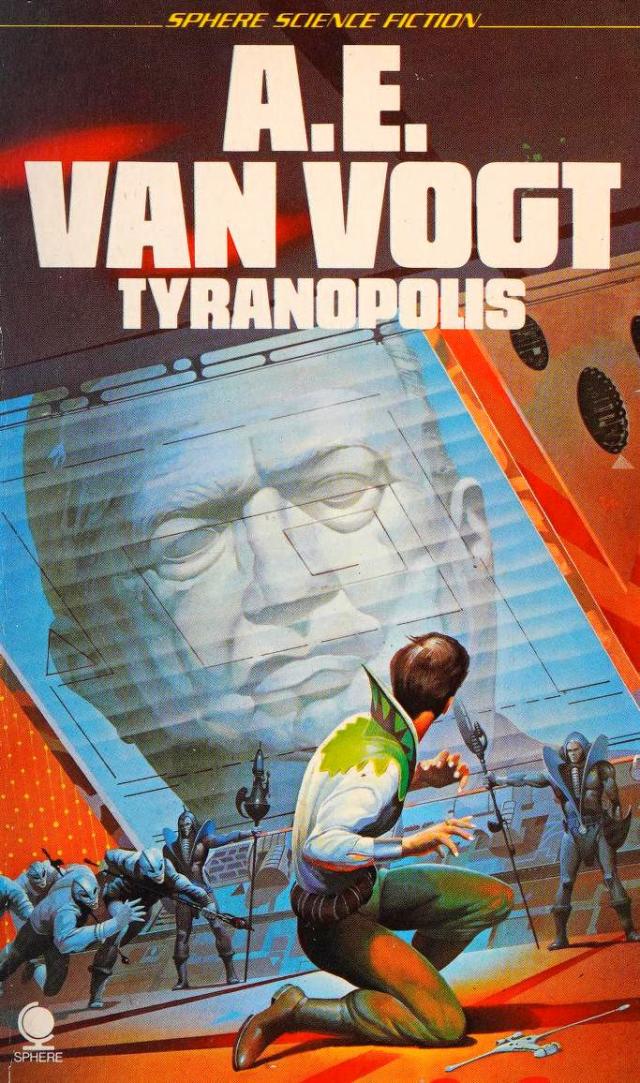
Tyranopolis
A. E. VAN VOGT
SPHERE BOOKS LIMITED
30/32 Gray’s Inn Road, London WCIX 8JL
AUTHOR’S INTRODUCTION
In mid-January, 1972, a super-talented friend of mine, Sam Locke, phoned me and said in a hushed voice, ‘I have just had a phone call from someone I went to school with, and who disappeared in 1947.’ Sam writes for TV and films, has had a play produced on Broadway, and has been a co-author on five Broadway musicals. His long lost school chum was one of those army casualties. He was taught to speak Chinese, and then, of course he was sent to France.
It turns out that in 1947 he decided to visit China. While in Shanghai he married a Chinese girl, and was still there when the Communists took over in ’49.
In 1971 he accompanied the Red China mission to the U.N. Naturally, he looked up his old friends. He wanted to fly out from New York, and ‘have one of those dinners your mother used to cook.’ That part would be private. But after the dinner Sam wanted to invite a few people to meet his former friend, and (he said), ‘Although I know you’re a Republican at heart, though you claim to be a registered Democrat, would you like to be one of the guests?’
(For the record, I’m a middle liberal without a leftist bone in my body; or a rightist bone. And I know what that means).
I said, ‘Sam, I’m one of the people who absolutely should be at that party; since I am an intellectual expert on Red China, and have written a researched novel on the subject.’ … In case you wonder why I’m telling this anecdote, the dictator in this story, TYRANOPOLIS, is a 23 rd century parallel to the career and character of the Russian despot, Joseph Stalin. The background of that future state also has elements in it of the China of Mao Tse-tung, the Chinese Communist leader. What I wish to establish is that I am qualified to do such a parallel.
My Red China novel, THE VIOLENT MAN (not science fiction) was published in 1962 by Farrar, Straus and Giroux, and subsequently ran through five Avon paperback printings. It took eight years to write. To write it, I read and reread approximately 100 books on China and Communism. At that time I learned the painful lesson of the student who does not underline salient points. Thus, in preparation for TYRANOPOLIS, I read, and underlined, KHRUSHCHEV REMEMBERS, Medvedev’s LET HISTORY JUDGE, and, for the picture of scientists in prison, Solzhenitsyn’s THE FIRST CIRCLE.
How did all this work out for me at Sam Locke’s party? Well, it turned out that Sam’s ‘few people’ consisted of about fifty individuals, most of whom were crowded around the guest of honour. He sat on a couch, and every seat near him was occupied. I did one of my system things. I settled down in a chair at the remote outskirts of this group. Whenever someone got up - which they did to get a drink, or whatever - I either got that chair; or, if someone else got it first, I took his. By this method, in approximately one hour I was sitting next to the only white man who accompanied the Red Chinese mission to the U.N.
I clung there approximately one hour; and, despite interruptions, I asked my questions.
Here are samples: ‘What is the dust situation in Peking today?’ (‘Solved,’ he answered.) ‘Are the Chinese still spitting on sidewalks, in railroad cars, everywhere?’ (‘No. The spitting problem was solved with millions of spittoons and psychological pressure - and that ended the common cold as a national calamity.) ‘What level of relationship is permitted between older boys and girls?’ (‘The situation is terrible,’ he said. ‘Because of the population thing, the pressure on the kids is so great, they virtually do not dare to speak to each other.’)
You may ask, did I believe his answers? Was the dust problem in Peking solved? (Starting about 75 years ago, Peking became, progressively, a dustier city. It even ‘snowed’ dust in winter. It was believed that wind shifts brought dust from the Gobi desert to this unhappy city. The Communist solution was to replant trees in strategic areas, so this gentleman said. When Nixon visited Peking, I looked for the trees, and there they were.)
We must remember that dictators can often solve problems by fiat. My dictator (in TYRANOPOLIS) created a ‘perfect’ world. You’ll have to decide for yourself if you care to pay the price of solutions by such a method.
Later in the evening, when I went over to Sam’s friend to say goodbye, he said, ‘You’re the only person I’ve met in the U JS. who knows anything about China. Why don’t you come and visit me in Peking when relations between the U.S. and China are normalized?’
Obviously, his was over-praise. There are in this country, academic experts, journalist experts, diplomatic experts, and people (like the late Henry Luce) who were born in China. Many of these, including a White Russian woman I know in Oregon, even speak the language fluently.
But I was in my time an intellectual expert. That is, a writer who took the laborious trouble to get his facts straight.
The same applies to all Communist references in TYRANOPOLIS, and to the entire psychology quoted or paraphrased in various parts of the story. Anti-communists, who somehow have thought of the whole pack of early Russian and Chinese Reds as gangs of semi-literate hill bandits, will be surprised to discover that they were intellectuals who had their own extensive terminology, which they understood perfectly. And which is used in my novel without so much as the alteration of a single letter.
In order to dramatize what might seem ‘heavy’ stuff, I decided on a very bizarre opening sequence, and to continue with other bizarre techniques. The result is a far-out fantastic novel without a visible trace of intellectuality.
But it’s there.
Table of Contents
ONE
THREE
FOUR
FIVE
SIX
SEVEN
EIGHT
NINE
TEN
ELEVEN
TWELVE
THIRTEEN
FOURTEEN
FIFTEEN
SIXTEEN
SEVENTEEN
EIGHTEEN
NINETEEN
TWENTY
TWENTY-ONE
TWENTY-TWO
TWENTY-THREE
TWENTY-FOUR
TWENTY-FIVE
TWENTY-SIX
TWENTY-SEVEN
ONE
Professor Dun Higenroth read the official letter with pursed lips:
‘… Your good fortune to have won the Accolade for your field … Hence, your decapitation on behalf of your students in the advanced educational programme … will take place on Patriotic Day. Congratulations …’
There was more, but that was the gist.
Silently, Higenroth handed the document across the breakfast table to his wife, Eidy. For no clear reason, he watched closely as that young lady read the news of the imminent beheading of her elderly husband, but she showed no visible emotion. She handed the paper back, and said, ‘The important thing to remember is that beheading doesn’t hurt. That’s been proved.’
Higenroth discovered as he now read the fine print, that there was a footnote about that very subject in the execution order:
‘… It is taken for granted that the Accolade winner will not allow anxiety about the actual moment of decapitation to show in his behaviour or be of any concern in his thoughts. Such old-style reactions are not for the modern, mature scientist, who understands the value of Accolade beheading to his students and knows that for him it is a step from this world into a better one, as has been established by the Official Religion.’
The award confronted Professor Higenroth with a dilemma. On the one hand - he had to admit it - it was a victory. His long battle with Dr. Heen Glucken had ended in a clean cut - so to say - knockout of his adversary. Accolade winners were clearly demarcated front runners in the struggle for scientific eminence.
In a single stroke - literally speaking - he would win the crown.
On the other hand, he did not quite feel that his work w as done. There’s still a lot of creativity in the old noodle,’ he said to Eidy. ‘And so I think I’ll ask for an indefinite postponement on the grounds of Future Glitter.’
Eidy said, ‘You don’t think this has anything to do with those political writings you’ve been publishing for two years against the regime?’
‘Oh, no.’ Higenroth shook his lean head. ‘The dictator has definitely stated that all viewpoints will be tolerated. The possibility that the Accolade is not earned is not a factor in the matter.’
‘Of course,’ said Eidy hastily.
Since Patriotic Day was only half a week distant, Higenroth made his application for postponement on a form provided and sent it to the Board of Advanced Education by magnetic jet special delivery.
The news of his award was on the morning telews. Early the next day, Dr. Glucken jetted in from overseas, as he put it, ‘to pay my final respects to a worthy opponent.’ He added, ‘I cannot say that I fully accept their judgement, but I think I have a solution that will satisfy me.’
He thereupon launched into a summary of his own views.
For some reason that he could not explain, Higenroth had not slept well; and so it was a little while before he alerted sufficiently to a realization that Dr. Glucken was off on the same old tiresome subject of airing his private theories.
‘… It would be a scientific triumph,’ Glucken was saying, ‘if your students at the time of decapitation not only received a flash of education in all of your special knowledge but also of mine.’
As the eager voice continued, Higenroth began to stir. Suddenly, he was galvanized. ‘Just a moment,’ he said. ‘Are you suggesting? -‘
Glucken went on with his presentation of certain basic theories, merely raising his voice.
Higenroth came more awake. ‘Hey!’ he said. ‘Are you trying to ensure that my students are educated in your ideas when J am decapitated?’
Glucken continued his summation, talking even louder.
Higenroth placed his hands over his ears and shouted that he would be damned if he would allow the Accolade Committee’s judgement to be perverted by ideas that were not of Accolade stature.
At this point, Eidy came rushing in. She hurriedly led her husband out of the room, but the two men yelled at each other until she had successfully shoved the professor through the door of his bedroom and closed the door.
Dr. Glucken, his lean, rather good-looking face red, was on the point of leaving the house when Eidy came hurrying back. She stopped him at the door. ‘Are you married?’ she asked.
‘My wife is dead,’ he replied. ‘She questioned the Official Religion.’ He shrugged. ‘I warned her.’
Eidy knew what he meant. That was the one forbidden action in an otherwise benign dictatorship.
What troubled her now was that she had married Higenroth when she was still one of his students under a government programme in which attractive teen-age girls were patriotically wed to famous scientists. Once a girl had been patriotic in this fashion she was usually expected to continue, and it seemed to her that Dr. Glucken was quite an attractive male for a scientist. And since he would be the unquestioned Number One in the field after the decapitation of her present husband, she now simpered a little as she shook his lean hand, holding it longer than was necessary. Then she drew back and waited anxiously, for this was a marriage she might be interested in. If this failed, who knew who she would get - another Higenroth?
But Dr. Glucken was inwardly shaking his head over the thought that had fleetingly come into his mind, also. The feeling was particularly strong for a moment as he noticed -he couldn’t help but notice - what an unusually pretty girl she was. But such a marriage might be taken as a sign of surrender on his part to Higenroth’s ideas, which of course could never be.
The sound of the doorbell shortly after the departure of Dr. Glucken brought traditional battlers into the house: Professor Higenroth’s students. Eidy, who opened the door, was smashed against one wall by a surging mass of young male and female bodies as, squealing, they poured past her, seeking their mentor.
The professor had emerged from the bedroom and had stripped himself for the bathtub. He half-turned, startled, when the first lapping pulse of the tidal wave of students -who were still pouring through the front door - caught him and swept him into the adjoining hallway; and so, battered but still alive, to the patio beyond. There, he was quickly tumbled to the grass.
A pair of clippers was produced. His hair was sheared off by this efficient instrument. Next, his head was shaved. While this transpired, he was aware that a raffle was being conducted, with two girls and two boys acting as arbiters. The raffle would decide which students won the ten choice positions on the professor’s valuable head.
The scientific study of the educational value of decapitation had resulted from an old folk observation: Gradually, after death, a human face ceases to look the way it did when alive. Family resemblance disappears. A stranger lies on the slab, in the coffin, in the ground.
Scientific investigators, working for the dictator - under a directive to seek ever new ways for transmitting knowledge to the younger generation - determined that the dead body, particularly the massively charged-up head, gradually loses its lifetime accumulation of information and conditioning. Normally, this simply drains off into the air. But tests demonstrated that the energy pulses could be drawn off into the heads of students by means of proper electrical connections. It was discovered - so it was claimed - that, when suddenly decapitated, the head released about 70% of its burden within a few minutes.
Thus the science of educational beheading was born under the firm directive of a farseeing dictatorship. In addition to its strictly utilitarian purpose, the method had become a means of giving recognition for meritorious scientific achievements to many persons who, because of their anti-government writings and activities, might never have been recommended for honours by over-zealous government agencies, smarting under criticism. This limitation on the part of loyal henchmen was recognized by the dictator, and - as he put it - the most useful redress made.
The student battle for head position had become an old tradition. And so, after his first startled reaction, Professor Higenroth submitted goodnaturedly to the minor indignities involved: a bloody scalp and a dizzy sense of having been battered by innumerable blunt instruments.
And, when they departed, he came to the door and cheerfully waved them goodbye.
On the morning after his second sleepless night, Professor Higenroth confessed to Eidy that for some reason, which was not clear to him, he was feeling concern about the moment of decapitation. All through the night - he reported - he had been literally haunted by endless images, which implied some kind of internal resistance to receiving the Accolade. In fact, he had even had fleeting moments when he found himself rejecting the Official Religion, with all its pleasant reassurances.
‘If this goes on,’ he said, ‘I may disgrace you by taking to my heels during this final night and heading for the Hills.’
The ‘Hills’ was a euphemism. The word referred to the anti-government forces who - it was rumoured - had their strongholds in great, fortified mountain regions. The rumour, Higenroth knew, was false. Modern arms made a physical redoubt anywhere on the planet unfeasible.
He saw that his words had quite properly alarmed Eidy. If an Accolade winner failed to show up at the block on Patriotic Day - tomorrow - a near relative substituted for him. The substitution had no educational value. It was merely a custom, designed according to official doctrine ‘to save the honour of the family, who naturally will not want to lose the Accolade.’
Since it was taken for granted that each family member would want such an honour for himself - of being the substitute - to prevent squabbling, an order of precedence had been established by decree: wife, father, mother, eldest brother, eldest sister, and so on. Children were exempted because the regime loved all children. However, if there were no near relatives, the next leading scientific contender for the Accolade fulfilled the honour.